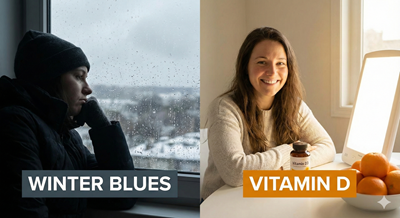
It’s 7:00 AM and your alarm goes off in the pitch black. You struggle to get out of bed. By the time you leave work, it’s dark again. You feel sluggish, unmotivated, and maybe a little down.
We often brush this off as just "hating the cold," but for millions of people, this seasonal slump is a biological reality. It is often linked to a drastic drop in Vitamin D, the "Sunshine Vitamin."
While we often associate Vitamin D with strong bones, emerging science suggests it plays a critical role in regulating your mood. And in the winter, your main source of it simply disappears.
1. The "Sunshine" Hormone
Vitamin D is unique because it functions more like a hormone than a vitamin. Receptors for Vitamin D have been found in the same areas of the brain that regulate mood and depression.
Research suggests a link between low levels of Vitamin D and low levels of Serotonin—the "feel-good" neurotransmitter that governs happiness and sleep regulation. When your Vitamin D levels tank, your serotonin production may struggle, potentially opening the door to the "Winter Blues" or, more formally, Seasonal Affective Disorder (SAD).
2. The Winter Trap: Why You Can’t Just "Go Outside"
In the summer, 15 minutes of direct sunlight is often enough for your skin to synthesize all the Vitamin D you need.
However, if you live in the Northern Hemisphere (like in Europe or North America), there is a catch. From roughly October to March, the sun sits at such a low angle in the sky that the UVB rays needed to produce Vitamin D essentially bounce off the atmosphere. They never reach your skin.
This means that even if you stood outside naked in January (which we don't recommend), you likely wouldn't produce any significant Vitamin D. During these months, your levels rely entirely on two things: your body's storage from summer, and what you eat.
3. The "Dietary Gap" (And Why It’s Hard)
Here is the bad news: Nature didn't put Vitamin D in very many foods. It is notoriously difficult to reach the recommended daily intake (often 600–2000 IU depending on guidelines) through a standard diet.
The Few "Super-Sources":
- Fatty Fish: Salmon, Trout, and Mackerel are the kings. A single serving of Sockeye Salmon can provide over 100% of your daily needs.
- Cod Liver Oil: An old-school remedy, but incredibly potent.
- Egg Yolks: They contain small amounts (about 40 IU per egg), so you’d need to eat a lot of omelets.
- Mushrooms (UV-Treated): Some mushrooms exposed to UV light can generate Vitamin D2, a plant-based version.
Conclusion
Your mental health is complex, and diet isn't a cure-all. However, giving your brain the biological building blocks it needs is the first line of defense.
Don't let the winter darkness dictate your mood. Check your Vitamin D intake on FoodTrackr today—bringing a little sunshine back into your life might be as simple as a piece of grilled salmon or a targeted supplement.
Track Your Nutrition with FoodTrackr
Get detailed insights into your vitamin and mineral intake with FoodTrackr.

Sources & Scientific Reference
Vitamin D & Mood Regulation:
Penckofer, S., Kouba, J., Byrn, M., & Estwing Ferrans, C. (2010).
Vitamin D and depression: where is all the sunshine? Issues in
Mental Health Nursing, 31(6), 385–393. (Explores the biological
mechanisms linking Vit D to mood).
Anglin, R. E., Samaan, Z., Walter, S. D., & McDonald, S. D. (2013). Vitamin D deficiency and depression in adults: systematic review and meta-analysis. The British Journal of Psychiatry, 202. (A major review of studies showing the correlation).
The "Winter Gap" (Solar Zenith Angle):
Webb, A. R., Kline, L., & Holick, M. F. (1988). Influence of season
and latitude on the cutaneous synthesis of vitamin D3: exposure
to winter sunlight in Boston and Edmonton will not promote vitamin
D3 synthesis in human skin. The Journal of Clinical Endocrinology
& Metabolism. (The landmark study proving winter sun doesn't work
for Vit D synthesis in northern latitudes).
Dietary Sources Data:
USDA FoodData Central. Nutrient content for Salmon (Sockeye),
Egg Yolks, and Mushrooms.
Disclaimer: This content is for informational purposes only and does not constitute medical advice. If you are experiencing symptoms of depression or seasonal affective disorder, please consult a healthcare professional.