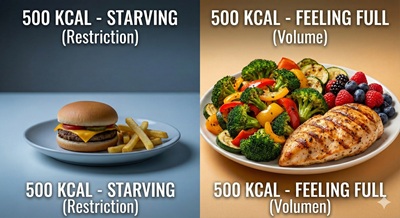
"Eat less, move more." It sounds simple, right? So why do so many of us download a tracking app, set a goal of 1,200 calories, starve for three weeks, and then eventually binge?
The problem isn't that you lack willpower. The problem is that you are trying to sprint a marathon. When you cut your calories too drastically, your body fights back with hunger hormones, fatigue, and intense cravings.
Effective weight loss isn't about starving; it's about finding the "sweet spot"—a deficit large enough to burn fat, but small enough to keep you energetic and full. Let's break down the science of doing it right.
1. Know Your Numbers: BMR vs. TDEE
Before you can cut calories, you need to know how many you burn. There are two acronyms you need to understand:
BMR (Basal Metabolic Rate): This is what you burn just by existing—breathing, thinking, pumping blood. Never eat below this number. Doing so can signal your body to slow down its metabolism to "survive."
TDEE (Total Daily Energy Expenditure): This is your BMR plus your movement (walking, working, gym). This is your "Maintenance Calories"—the amount you eat to stay exactly the same weight.
The Golden Rule: You want to eat below your TDEE, but above your BMR.
2. The "Goldilocks" Deficit
Many beginners try to cut 1,000+ calories overnight. This is a recipe for disaster.
Research consistently shows that a moderate deficit of 300 to 500 calories below your maintenance level is sustainable.
Math: A 500 calorie deficit per day = 3,500 deficit per week ≈ 0.5 kg (1 lb) of fat loss.
Reality: This might feel slow, but it is permanent. It allows you to have a life, go out for dinner occasionally, and maintain your muscle mass.
3. How to Eat Less But Feel Full (Volume Eating)
A calorie is a calorie for weight loss, but not for hunger.
200 Calories of Oil: 1.5 Tablespoons. (Your stomach feels empty).
200 Calories of Broccoli: An entire massive bowl. (Your stomach is physically stretched).
This is called Volume Eating. By filling your plate with low-calorie, high-fiber foods (vegetables, fruits), you physically stretch your stomach, triggering "fullness" signals to your brain.
The Protein Factor: Protein is the most satiating macronutrient. It takes longer to digest and reduces the hunger hormone ghrelin. If you are in a deficit, keeping your protein high is the cheat code to not feeling hungry.
4. Don't Just Guess—Calculate.
You don't need a PhD in math to figure this out. FoodTrackr does the heavy lifting for you.
- Set Up Your Profile: Enter your height, weight, and activity level accurately. Be honest about your activity!
- Choose "Sustainable" Goals: When the app asks for your goal, choose a moderate pace (e.g., 0.5 kg/week) rather than "lose weight as fast as possible."
- Focus on Macros: Use the app to ensure that even though your calories are lower, your Protein intake remains high.
Conclusion
Weight loss is a data game, not a suffering contest. If you are waking up hungry, dizzy, or obsessed with food, your deficit is too big.
Use FoodTrackr to find that perfect balance. Tracking isn't about restricting yourself into misery; it's about giving yourself the freedom to eat the foods you love while still moving toward your goals—one well-calculated meal at a time.

Track Your Nutrition with FoodTrackr
Get detailed insights into your vitamin and mineral intake with FoodTrackr.

Sources & Scientific Reference
The Rate of Weight Loss & Sustainability:
Centers for Disease Control and Prevention (CDC). "Losing Weight:
Getting Started." (Recommends the 1-2 lbs/week standard for long-term
success).
Heymsfield, S. B., et al. (2011). Energy deficits required for weight loss: a healthy young woman analysis. (Critiques the old 3500-kcal rule and offers modern precision, but supports moderate deficits).
Protein & Satiety:
Leidy, H. J., et al. (2015). The role of protein in weight loss
and maintenance. The American Journal of Clinical Nutrition. (Key
study showing higher protein diets lead to greater fullness and
better weight maintenance).
Volume & Energy Density:
Rolls, B. J. (2017). Dietary energy density: Applying behavioural
science to weight management. Nutrition Bulletin. (Research by
Dr. Barbara Rolls, the pioneer of "Volumetrics," showing that
low-density food leads to spontaneous calorie reduction).
Metabolic Adaptation (Why Starving Fails):
Müller, M. J., et al. (2015). Metabolic adaptation to caloric
restriction and subsequent refeeding: the Minnesota Starvation
Experiment revisited. (Explains how drastic restriction lowers
BMR).