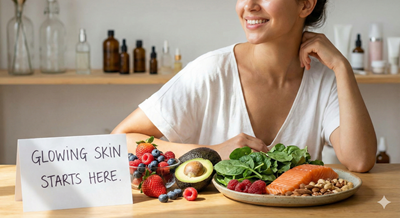
Open your bathroom cabinet. How many serums, moisturizers, and "glow-inducing" masks do you see? The beauty industry is a multi-billion dollar machine built on the premise that great skin is something you apply from the outside.
While a good moisturizer helps, it’s missing the bigger picture. Your skin is your body’s largest organ. Like any organ, its health depends entirely on the fuel you provide it.
You cannot out-moisturize a deficient diet. If your body doesn't have the building blocks to create healthy skin cells, no amount of expensive topical cream will fix the underlying issue.
Today, we are ditching the Sephora aisle for the produce aisle to explore the three pillars of "ingestible skincare": Collagen, Vitamin A, and Vitamin E.
1. Collagen: The Scaffolding of Your Skin
Collagen is the most abundant protein in your body. Think of it as the scaffolding that holds your skin up, keeping it plump, elastic, and smooth. As we age, our natural collagen production slows down, leading to sagging and wrinkles.
The Supplement Trap
The market is flooded with collagen powders. While they might help, simply eating collagen doesn't guarantee it goes straight to your face. Your body breaks down dietary protein into amino acids and then decides where those building blocks are needed most.
The Nutritional Hack: Vitamin C
If you want your body to build its own collagen scaffolding efficiently, you need the foreman: Vitamin C. Without adequate Vitamin C, your body cannot synthesize collagen effectively.
Eat your sunscreen: Think beyond oranges. Red bell peppers, kiwi, strawberries, and broccoli are powerhouse sources of Vitamin C essential for collagen production.
2. Vitamin A: The Original "Retinol"
You have likely heard of Retinol, the gold-standard anti-aging ingredient in topical creams. Retinol is simply a derivative of Vitamin A.
Internally, Vitamin A is crucial for cellular turnover. It dictates how fast your body sheds dead skin cells and replaces them with fresh, new ones. A deficiency can lead to dry, flaky skin or clogged pores (hyperkeratinization).
Two Ways to Get It:
- Preformed Vitamin A (Retinoids): Found in animal products like beef liver (the ultimate source), eggs, and dairy. Your body uses this form easily.
- Provitamin A (Carotenoids): Found in colorful plants like carrots, sweet potatoes, and spinach. Your body must convert these into active Vitamin A.
Tip: If you rely on plant sources, eat them with some healthy fat (like olive oil) to significantly increase absorption.
3. Vitamin E: The Internal Shield
Every day, your skin is under attack from UV rays, pollution, and stress. These create "free radicals"—unstable molecules that damage cells and accelerate aging (think of it like rust on a car).
Vitamin E is your body’s primary fat-soluble antioxidant. It incorporates itself into your cell membranes to act as a shield, neutralizing free radicals before they can cause damage. It is essentially internal photoprotection.
Where to find it: Vitamin E is abundant in healthy fats. Almonds, sunflower seeds, avocados, and olive oil are excellent sources to protect your skin from the inside out.
The Missing Ingredient: Consistency (and Tracking)
Knowing what to eat for glowing skin is easy. The hard part is ensuring you get enough of these nutrients every single day.
It’s difficult to look at a chicken salad and know if you hit your daily Vitamin A requirement. This is where many people fail—they eat "generally healthy" but still miss key micros.
Stop Guessing, Start Glowing
This is where FoodTrackr becomes your best skincare tool. By logging your food, you can look past the calories and see the actual micronutrient breakdown.
Check your dashboard right now:
- Are you hitting 100% of your Vitamin C to support collagen?
- Is your Vitamin E intake low, leaving your skin unprotected?
Before you buy another expensive cream, try hitting your micronutrient goals for 30 days. You might find that the best glow-up didn't come from a bottle, but from balancing your diet.

Track Your Nutrition with FoodTrackr
Get detailed insights into your vitamin and mineral intake with FoodTrackr.

Sources & Scientific Reference
The Role of Nutrition in Skin Health:
Schagen, S. K., Zampeli, V. A., Makrantonaki, E., & Zouboulis,
C. C. (2012). Discovering the link between nutrition and skin
aging. Dermato-endocrinology, 4(3), 298–307. (An excellent overview
of how diet affects skin aging).
Vitamin C & Collagen Synthesis:
Pullar, J. M., Carr, A. C., & Vissers, M. (2017). The Roles of
Vitamin C in Skin Health. Nutrients, 9(8), 866. (Details Vitamin
C's essential role as a co-factor for collagen enzymes).
Vitamin E as Photoprotection:
Keen, M. A., & Hassan, I. (2016). Vitamin E in dermatology. Indian
dermatology online journal, 7(4), 311–315. (Explains Vitamin E's
antioxidant role in protecting skin barrier function).
Vitamin A & Cellular Turnover:
Oregon State University, Linus Pauling Institute. Micronutrient
Information Center: Vitamin A and Skin Health. (A leading authority
on micronutrient functions).