

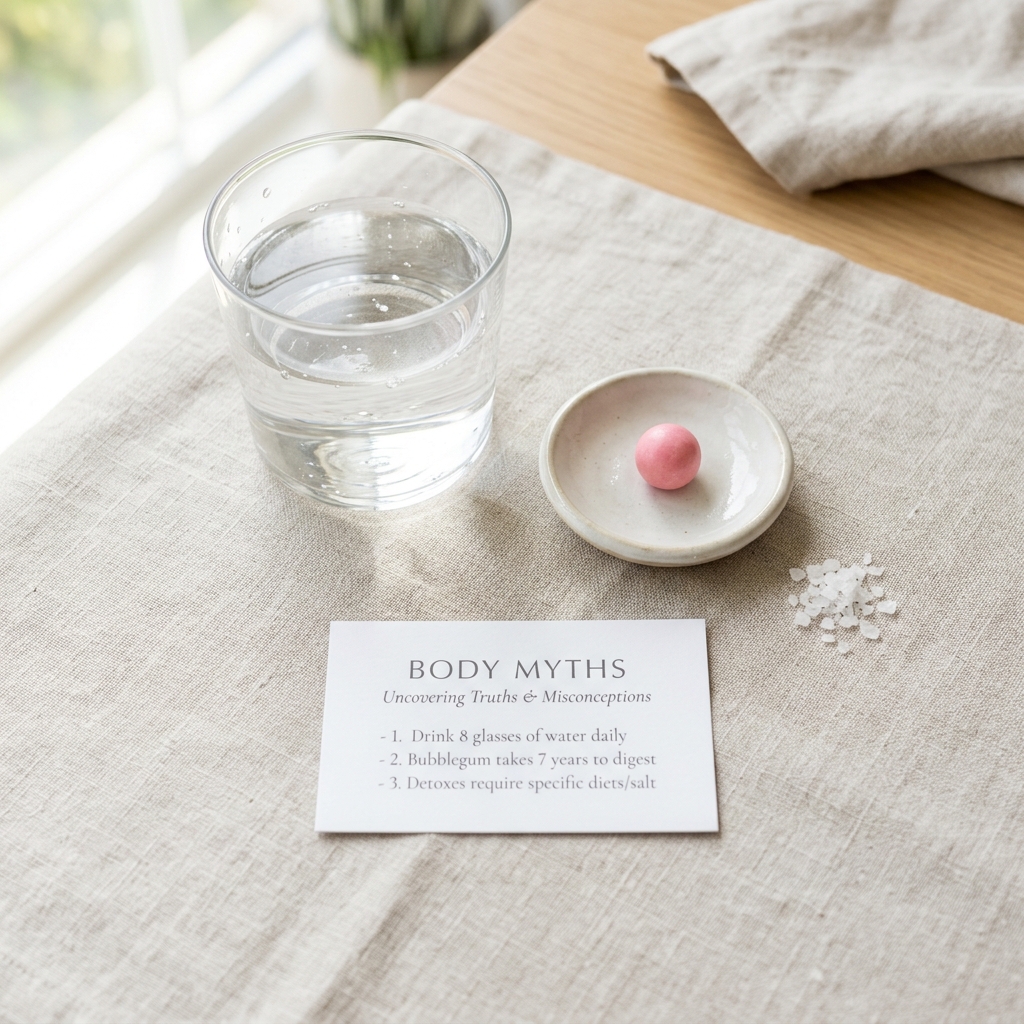
Our bodies are incredibly complex, and over the years, many old wives' tales and folklore have emerged to explain how they respond to what we consume. From childhood warnings about swallowed candy to warnings about our morning cup of coffee, many of these myths have been repeated so often they are accepted as fact.
But what does medical science actually say? Let's take an honest, evidence-based look at four of the most common everyday body myths.
Myth 1: Swallowed Chewing Gum Stays in Your Stomach for 7 Years
Almost everyone was warned by their parents as a child: *“Don’t swallow your chewing gum, it will stick to your stomach and stay there for seven years!”*
The Reality: This is a classic scare tactic. While it is true that your stomach cannot digest the synthetic gum base (elastomers and resins), your digestive system doesn't just let things sit around. The stomach muscles and intestines continue their normal contractions, slowly moving the gum along. It passes through your digestive tract completely intact and is excreted in your stool within 24 to 48 hours. While you shouldn't swallow large amounts of gum routinely (as it can cause blockages in rare cases, especially in children), an occasional swallowed piece is completely harmless.
Myth 2: Coffee Dehydrates the Body
For decades, health guides recommended drinking a glass of water with every cup of coffee. The reasoning was that caffeine is a diuretic, meaning it makes you urinate, and therefore causes a net loss of fluids that dehydrates your body.
The Reality: Caffeinated beverages do not dehydrate you when consumed normally. While caffeine does have a mild diuretic effect, the water content in your coffee or tea more than compensates for the fluid lost. Medical studies show that regular coffee drinkers develop a tolerance to caffeine's diuretic properties, and caffeinated drinks contribute to your daily hydration goals just like regular water. You can count your morning brew toward your total daily fluid intake!
Myth 3: Salt is Pure Poison and Should Be Avoided Completely
Salt (sodium chloride) is often labeled as the ultimate dietary villain. We are warned that eating salt raises blood pressure, damages blood vessels, and increases the risk of heart disease, leading many to believe that the healthier choice is a completely salt-free diet.
The Reality: Sodium is a vital electrolyte that your body absolutely needs to survive. It regulates blood volume, controls blood pressure, and is essential for nerve transmission and muscle function. While a high intake of processed foods can lead to excessive sodium levels (which can be problematic for individuals with salt-sensitive hypertension), a radical restriction of salt is not healthy either. Extremely low sodium levels can trigger hormonal imbalances and increase insulin resistance. For healthy individuals cooking mostly whole foods at home, normal salt usage is safe and necessary.
Myth 4: There is Nothing You Can Do Against "Brain Freeze"
You take a large bite of ice cream or a sip of a cold slushie, and suddenly, a sharp, stabbing headache hits your temples. This phenomenon is known as "brain freeze" or *sphenopalatine ganglioneuralgia*. Many believe you just have to suffer through the pain until it goes away.
The Reality: Brain freeze happens when extreme cold touches the roof of your mouth (the palate). The rapid drop in temperature causes the blood vessels in your palate to constrict immediately. To protect the brain, your body reacts by dilating the vessels in your head rapidly, sending a surge of blood that is interpreted as pain by the trigeminal nerve. You don't have to wait it out: you can stop it instantly by pressing the flat of your tongue against the roof of your mouth. Your warm tongue transfers heat to the palate, signaling the blood vessels to normalize and stopping the headache in seconds.
Web Resources
For further reading on how your body handles these substances, check out these articles:
- Mayo Clinic: Swallowed chewing gum: Is it harmful?
- Mayo Clinic: Caffeine: Does it dehydrate you?
- Harvard T.H. Chan School of Public Health: Salt and Sodium
Conclusion
Many common body myths are based on outdated science or simple misunderstandings. Knowing the facts allows you to enjoy your coffee, salt your food moderately, and eat your ice cream (using the tongue trick!) without unnecessary worry.
To ensure you are getting the right balance of fluids, electrolytes, and nutrients, use the FoodTrackr app. It makes logging your diet simple and gives you clear insights into what your body actually needs.